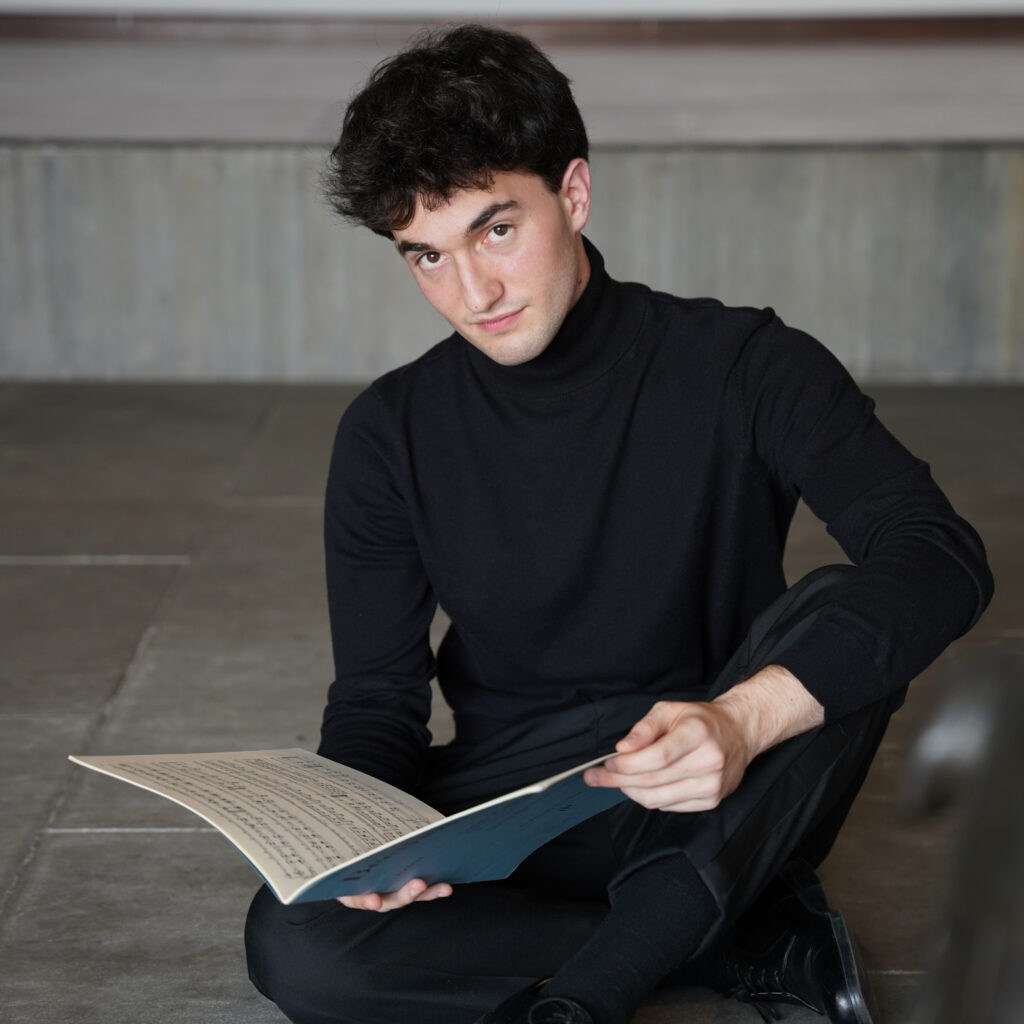
THE HAGUE RECORDINGS
Marcello Rolff plays R. Schumann “Faschingsschwank aus Wien”
Marcello Rolff’s recordings at the Royal Conservatoire of The Hague capture a vivid interpretation of Robert Schumann’s Faschingsschwank aus Wien, Op. 26, one of the most imaginative and virtuosic cycles in the Romantic piano repertoire. Recorded in the inspiring environment of this prestigious institution, the sessions reveal both technical mastery and deep interpretative insight, highlighting Rolff’s sensitivity to Schumann’s unique fusion of lyricism, humor, and structural complexity.
Composed in 1839 during his stay in Vienna, Faschingsschwank aus Wien (“Carnival Jest from Vienna”) occupies a distinctive place within the piano works of Robert Schumann. The piece emerged at a particularly intense moment in Schumann’s life. He had arrived in Vienna full of artistic and professional hopes, yet the experience soon proved more complicated and disappointing than expected. This emotional ambivalence—between enthusiasm and disillusionment, outward brilliance and inner unrest—seems deeply reflected in the character of the work.
The title explicitly evokes the atmosphere of the Viennese Carnival, with its world of festivity, masks, and spontaneity. Yet, as so often in Schumann’s music, the social reference is only the surface of a much more complex emotional landscape. Beneath the work’s sparkle and vitality lies a shifting psychological narrative shaped by sudden changes of mood, passionate surges, and moments of intimate lyricism. Rather than depicting a literal carnival scene, Schumann appears to suggest an inner carnival, where masks become metaphors for the many facets of the Romantic self.
Within Schumann’s piano output, Faschingsschwank aus Wien occupies a fascinating middle ground. It lacks the overtly programmatic framework of Carnaval and the inward simplicity of cycles such as Kinderszenen. Instead, it combines concert brilliance with imaginative character writing in a large, multi-movement design. The piano writing is often expansive and virtuosic, at times acknowledging the brilliant Viennese pianistic tradition; yet even in its most extroverted moments, Schumann’s distinctive poetic voice remains unmistakable.
One of the work’s most striking features is its constant expressive mobility. The festive spirit suggested by the title is never merely carefree or uniform. Schumann favors contrast and transformation: passages of dazzling energy give way to episodes of introspection and shadow. This expressive volatility reflects the famous duality that runs throughout his music—the impetuous Florestan and the inward Eusebius. Even without being explicitly named, these two psychological poles seem to animate the entire cycle, creating a continuous dialogue between outward theatricality and inward reflection.
Stylistically, the work presents Schumann at his most outwardly brilliant, yet never superficial. The virtuosic elements, though prominent, are never purely display-driven; instead, they serve a broader poetic purpose, helping to shape a kind of wordless musical drama. The unity of the piece arises less from strict thematic development than from a strong coherence of character and atmosphere, bound together by the recurring idea of masking and emotional transformation.
Within the broader landscape of Romantic piano literature, Faschingsschwank aus Wien stands as a vivid example of Schumann’s ability to transform piano music into a theater of the inner life. While a first hearing may impress through its brilliance and energy, a deeper listening reveals the subtle emotional ambiguity that permeates the work. The carnival becomes, in Schumann’s hands, a profoundly Romantic symbol: beneath the playfulness, light, and motion, a more restless and sensitive human voice continually emerges. It is precisely this delicate balance between exuberance and introspection that gives the work its lasting fascination and its special place in the Schumann repertoire.
I. ALLEGRO
The opening movement of Faschingsschwank aus Wien, Op. 26 by Robert Schumann immediately establishes the emotional and dramatic tone of the work. Written in B-flat major and marked Sehr lebhaft, it is the most expansive and theatrically brilliant movement of the cycle. From the first notes, the music evokes the vivid spirit of a Viennese carnival, full of energy, playfulness, and sparkle.
Unlike the final movement, which is in sonata form, this first movement is written as a rondò. This choice reflects the idea of the work as a “sonata in reverse”: the more playful and extroverted movement comes first, while the formal, developmental climax is reserved for the finale. In the rondò structure, a recurring main theme alternates with contrasting episodes, creating variety and surprise while maintaining a clear sense of cohesion. The main theme is bold, rhythmic, and cheerful, but Schumann frequently introduces shifts of mood and sudden changes of character, revealing his characteristic blend of wit and poetic depth.
Throughout the movement, the listener will notice the interplay between brilliance and lyrical moments. Beneath the outward festivity, there are passages of introspection and subtle emotional complexity, offering a glimpse of the Romantic tension between external exuberance and inner reflection. A particularly playful historical gesture is Schumann’s subtle quotation of the Marseillaise, which adds a layer of irony and quiet defiance.
The rondò episodes vary in character—sometimes energetic and restless, sometimes more tender and lyrical—before the recurring main theme returns each time with renewed vitality. This continual alternation keeps the listener engaged, making the movement feel like a lively, ever-changing miniature drama.
As the opening to Faschingsschwank aus Wien, this rondò draws the audience into Schumann’s carnival world: dazzling and sparkling on the surface, yet rich in emotional nuance beneath. It prepares the way for the journey ahead, where the finale will provide the formal and structural culmination in full sonata form.
II. ROMANZE
The second movement of Faschingsschwank aus Wien, the Romanze in G minor, provides an immediate contrast to the brilliant opening rondò. The music begins with a delicate and highly lyrical section, almost like a Lied without words, supported by an opening C minor chord. This introduction has a deeply Germanic, introspective, and poetic character, inviting the listener into a more intimate and reflective space.
Soon, the movement opens into a broader, more communal middle section, resembling a chorale, in C major. Here the writing becomes more harmonious and expansive, as if multiple voices are joining together, while still retaining Schumann’s characteristic Romantic sensitivity. The contrast between the initial soloistic material and the central chorale creates a sense of emotional expansion, a dialogue between inward reflection and outward openness.
After the chorale, the music returns to the opening material, revisiting the more soloistic and lyrical lines, now enriched by the experience of the central chorale. The Romanze ultimately concludes on a G major chord, gradually slowing, leaving a sense of peace and poetic suspension.
In this movement, the listener encounters the most introspective and Romantic side of the work: a world of sweetness, sensitivity, and depth, emerging through the interplay of solo lyricism and chorale-like harmony, offering a moment of poetic pause before the livelier episodes of the following movements.
III. SCHERZINO
The third movement of Faschingsschwank aus Wien, the Scherzino in B-flat major, immediately returns the listener to the playful and sparkling spirit of the Carnival. Short and light, this movement has a decidedly capricious and witty character, as if a mischievous mask were darting across the stage, hopping between little surprises and sudden shifts of mood.
The music is transparent and lively, with quick, agile lines that evoke the lightness and irony typical of Schumann. Despite its brevity, the Scherzino possesses an infectious energy and a sense of constant motion, where each phrase seems born from a spontaneous impulse, as if the composer were telling a tiny musical scene without words.
This movement functions as a playful interlude between the lyrical depth of the Romanze and the dramatic tension of the following Intermezzo, preparing the listener for the emotional contrasts in the central part of the work. The overall effect is one of bright, cheerful relief, a moment of levity and theatrical charm that reveals Schumann’s most whimsical and spirited side.
IV. INTERMEZZO
The fourth movement of Faschingsschwank aus Wien, the Intermezzo in E-flat minor, is one of the moments of greatest intensity in the entire work. Schumann writes on the score the indication “Mit größter Energie”, meaning “with the greatest energy”, which defines the character of the movement: music full of tension, drive, and remarkable lyricism.
The Intermezzo can be seen as almost a climax of the cycle: the expressiveness reaches an extraordinary level, with moments of profound emotional engagement. The writing opens with intervals that gradually widen, creating a sense of lyrical expansion and contributing to the movement’s dramatic force. The E-flat minor harmonies, together with dynamic contrasts, further enhance this feeling of intense tension.
This movement serves as a bridge to the finale, accumulating energy and lyrical momentum that will find their resolution and fulfillment in the concluding movement, which is structurally more solid and in sonata form. The Intermezzo thus prepares the listener for a moment of deep emotional participation, increasing the impact of the final movement.
V. FINALE
The fifth movement of Faschingsschwank aus Wien, the Finale in B-flat major, closes the work with a return to brilliant energy and lively vitality. Here Schumann employs a clearly symphonic writing, similar in breadth and development to the first movement: thematic ideas unfold as in a full orchestral discourse, with continuous plays of tension and release, interplay between voices, and a strong sense of musical architecture that engages the listener.
Unlike the first rondò, the Finale is structured in sonata form, with clear exposition of the main themes, a rich development, and a conclusive recapitulation, yet it retains all the brilliance, dynamism, and vitality characteristic of the cycle. The music is driving and luminous, with an energetic rhythm and soaring melodic lines that demonstrate Schumann’s ability to combine pianistic virtuosity with poetic expressiveness.
This movement represents the culmination of the work: after the bright opening of the first movement, the lyrical Romanze, the playful Scherzino, and the intense tension of the Intermezzo, the Finale resolves all the accumulated energy. The symphonic element, together with the sonata form, creates a sense of grandeur and completeness, leaving the listener with an impression of momentum, brilliance, and musical satisfaction.

Slow Foot Classic is an Italian booking and artistic consultancy agency based in Italy. The agency is dedicated to promoting young talents, offering professional support in the programming of concerts, series, and thematic projects, as well as in collaboration with institutions, festivals, and concert seasons.
Newsletter
Orari
- 9.00-18.00 Lunedì-Sabato
SLOW FOOT MUSIC
Associazione Culurale
Via dei Landi 7/27
16151 - Genova - Italia
ph. +39 338 5252 398
ph. +39 351 2940 394
Email: info@slowfootmusic.com
Codice Fiscale 92546730105
Amiamo la musica.
Amiamo la gente.
Ecco perchè suoniamo.
Copyright Slow Foot Music 2026
All rights reserved
Copyright ©️ Slow Foot Music 2024. All Rights Reserved.

